News
15th Social Business Day Convenes Global Leaders to Reimagine Healthcare and Social Transformation
The 15th Social Business Day was successfully held from June 27–28, 2025, at the Samajik Convention Centre in Zirabo, Savar, Dhaka, Bangladesh, under the compelling theme: “Social Business is the Most Efficient Path to Ensure Healthcare for All.” Jointly organized by the Yunus Centre and the Grameen Group, the event aimed to underscore the transformative potential of social business as a sustainable, inclusive, and purpose-driven model to address global healthcare challenges.
The two-day international forum brought together more than 1,200 delegates from 37 countries, including a distinguished lineup of healthcare professionals, entrepreneurs, investors, policymakers, academics, youth leaders, and development experts. Representing Nepal, 23 delegations led by Mr. Shankar Man Shrestha, Chairperson of the Centre for Self-help Development (CSD), actively participated in various sessions. Additionally, CSD sponsored two best members from the 3ZERO Clubs of Jeevan Bikas Laghubitta Bittiya Sanstha Ltd. and Chameli Saving and Credit Cooperative Society Ltd. to participate in the event.
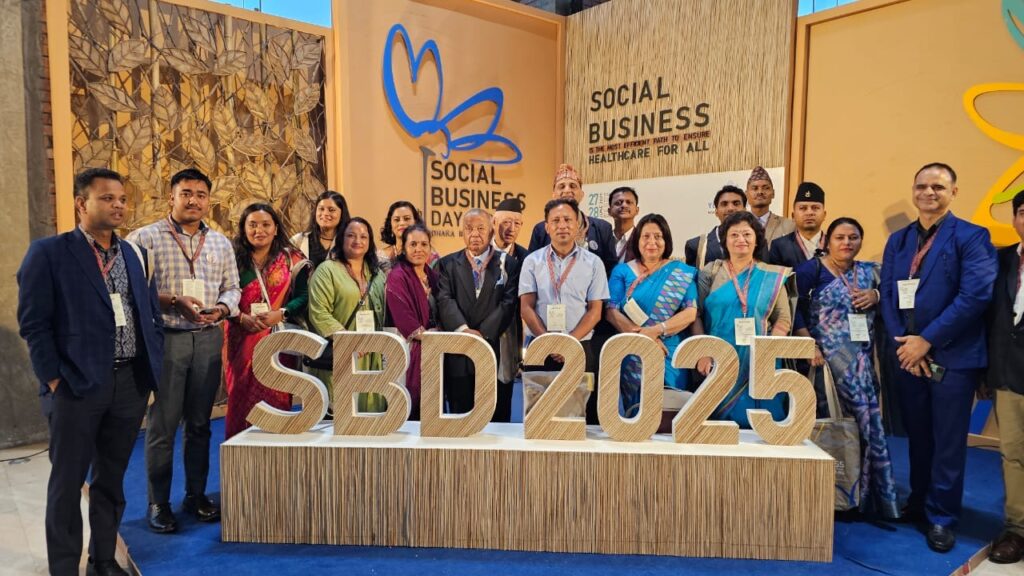
Participants at 15th SBD
The event commenced with a vibrant cultural presentation celebrating the heritage of Bangladesh, setting a dynamic tone for thoughtful dialogue and collaboration. In his keynote address, Nobel Peace Laureate and Chief Advisor of the People’s Republic of Bangladesh, Professor Muhammad Yunus, called for a fundamental redefinition of healthcare as a social business. “Ideas spark more ideas. And when innovation is driven by purpose, it creates lasting change. Healthcare must not be a commodity for profit or a handout for charity. It must be redefined as a Social Business — a purposeful, sustainable model that addresses systemic challenges and ensures healthcare for all.,” Prof. Yunus asserted. His message framed the overall discourse, emphasizing the need for ethical, inclusive, and people-centered healthcare systems.
A central theme of the event was addressing global inequities in healthcare access, particularly among marginalized populations. Panel discussions explored how social business models, technological innovation, inclusive policy frameworks, and cross-sector partnerships can be leveraged to design healthcare systems that are affordable, preventive, and ethically sound. The goal was to pave the way for resilient and sustainable health solutions that reach every individual, regardless of socio-economic status.
The first plenary session, titled “The 3Ds Transforming Healthcare”, focused on the transformative interplay of Democracy, Demographics, and Digitalization in advancing equitable healthcare. Discussions highlighted the role of participatory governance, demographic shifts, and emerging digital technologies—such as telemedicine, AI-based diagnostics, and mobile health tools—in expanding healthcare access. The second plenary, “Youth in Action: Meet Your Everyday Heroes,” showcased inspiring stories of young social entrepreneurs whose innovations in tech, sustainability, and community engagement are catalyzing change. The session stressed the importance of mentorship, financing, and supportive policy environments to scale youth-led enterprises.
A significant highlight was the global launch of “Shukhee”, an inclusive digital health platform developed by Grameen HealthTech. With over 2.8 million users and 68,000+ video consultations to date, Shukhee has expanded its reach through shortcode 10657 for feature phone users and rural ambassadors. During the launch, an MoU was signed with Nepal’s Centre for Self-help Development, making Nepal the first international adopter of the Shukhee model—a landmark moment in cross-border healthcare collaboration.
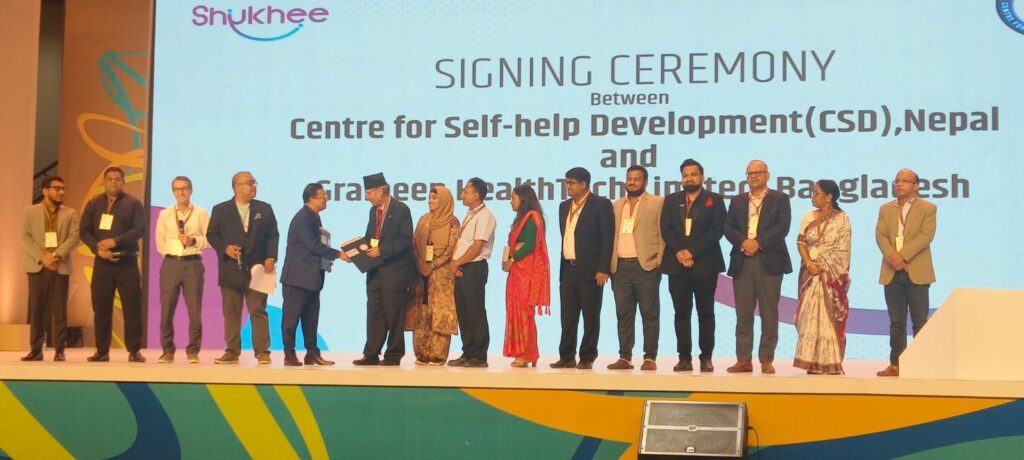
CSD signing MoU with Grameen Healthtech Limited
Delegates then participated in eight thematic breakout sessions focused on issues such as climate resilience, entrepreneurship, and financial inclusion. The Nepalese delegation notably attended Breakout Session 5: “Financial Inclusion for Zero Poverty,” where CSD Chairperson Mr. Shrestha provided compelling insights into the role of mission-aligned financial systems in poverty eradication. He cautioned against the growing mission drift within microfinance institutions and advocated for a paradigm shift to view the poor not as liabilities but as partners in economic progress. He also shed light on Nepal’s ongoing youth migration crisis—where over 700,000 young people leave the country annually—urging the creation of local opportunities to reverse this trend through entrepreneurship and inclusive finance. He further recommended promoting locally driven entrepreneurship, drawing inspiration from successful initiatives such as Bangladesh’s NOBIN UDYOKTA model.
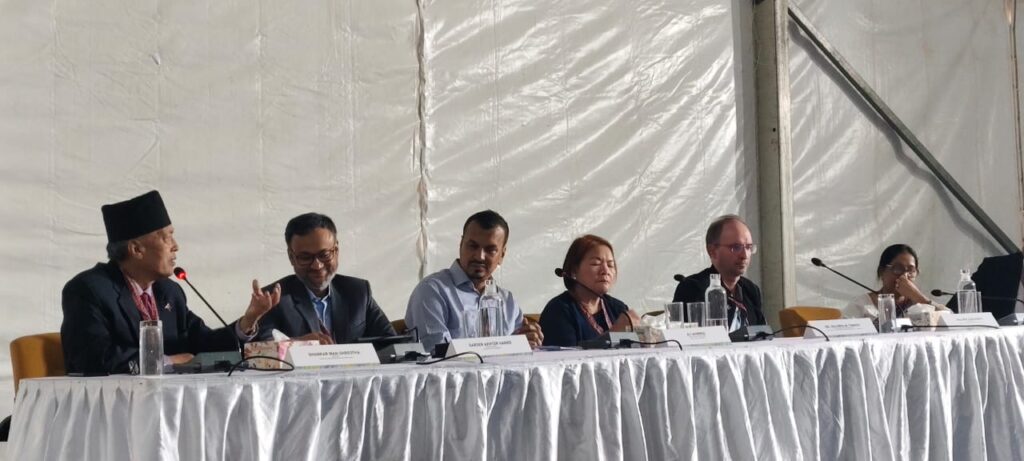
Mr. Shankar Man Shrestha as a speaker in Breakout Session
The second day of the 15th Social Business Day was focused on broader global challenges, including environmental protection and systemic resilience. The plenary session titled “One Planet – From the Sundarbans to the Amazon” emphasized community-driven conservation and climate adaptation. Speakers discussed the vital role of indigenous knowledge, sustainable practices, and social business in preserving biodiversity and supporting climate-vulnerable communities.
During the Feedback Report from the Regional Forum, Mr. Sanjay Kumar Mandal, CEO of Jeevan Bikas Laghubitta Bittiya Sanstha Ltd explained about the key focus areas during the Nepal Country Forum, 2025 that included youth entrepreneurship, eco-villages and support for the hardcore poor, the expansion of 3ZERO Clubs, and innovative health solutions for marginalized communities. He further stated that the forum underscored the transformative potential of social business in building inclusive, accessible, and sustainable healthcare systems. As a result, a comprehensive Two-Year Action Plan was formulated, outlining clear commitments: to empower youth by establishing 50 entrepreneurship incubation centers; to develop 50 eco-villages benefiting 20,000 individuals from hardcore poor communities; to form 4,000 new 3ZERO Clubs nationwide; and most significantly, to launch a dedicated social business enterprise titled “Healthcare for the Poor”, aimed at delivering affordable and equitable health services to underserved populations across the country.
Another major session, “Preparing Our Systems and Infrastructure for Challenges,” explored strategies to strengthen critical social sectors such as health, education, and nutrition, especially in the face of future shocks like pandemics and climate disruptions. Panelists advocated for integrated, technology-enabled systems that prioritize innovation, equity, and long-term sustainability.
The day concluded with the final plenary session, “Access to Finance and Social Impact,” where experts presented innovative financial models—ranging from ethical microfinance and social impact investing to community-based financing—as crucial tools to achieve the 3ZERO Goals: zero poverty, zero unemployment, and zero net carbon emissions. The session reaffirmed that financial systems aligned with social missions are vital for scaling inclusive development.
The event closed with a reflective segment titled “Global Reflections: Partnerships for a Just Future,” encapsulating key insights and collaborative commitments from the two-day event. In his concluding remarks, Mr. Md. Ashraful Hassan, Chairman of the Grameen Group, extended his gratitude to all participants and reaffirmed the organization’s steadfast dedication to promoting social business as a vehicle for global equity, sustainability, and human dignity.


